Commodity Trading Basics-
Futures and Options 101
Learn the most effective strategies for buying and selling options on
futures contracts. Also learn producer and consumer hedging strategies.
What are options?
Many people are intimidated by the unlimited risk potential when trading futures
contracts. Margin calls can and do happen when trading futures
or granting naked options. Long options have limited risk and many investors choose them to trade
over commodities futures contracts for that reason. Your maximum risk when purchasing an option is loss of the premium paid plus your commission and fees.
Therefore your account can't go negative as can happen in a futures contract. An option
gives the purchaser the right but not the obligation to buy or sell a futures contract, at a predetermined price (strike price) on or before a predetermined expiration date.
To go long (buy) an option requires a buyer (holder) to pay a premium. When going short
an option, the seller (writer or grantor) receives a premium but is liable for the entire contract value.
Therefore option grantors' risks are similar to that of a futures
contract trader.
Click
here to learn more about selling options on futures contracts.
What is a call option?
A call option gives the purchaser the right but not the obligation to buy an underlying futures contract. Purchasing a call means that you are expecting higher prices for the underlying commodity. Let’s assume you purchased a December Crude Oil $60 call option. You bought the right but not the obligation to buy 1,000 barrels of December crude oil for $60 per barrel.
What is a put option?
A put option
gives the purchaser the right but not the obligation to sell an underlying futures contract. Purchasing a put means that you are expecting lower prices for the underlying commodity. Let’s assume that you purchased a November Soybean $5 put option. You bought the right but not the obligation to sell 5,000 bushels of November soybeans at $5 per bushel.
How is the value of an option figured out?
To understand option trading basics first you have to understand the meaning of intrinsic and extrinsic
value. The option premium is made up of both of these values. Intrinsic is the value of the option if you exercised it to the futures contract and then offset it. For example if you have a Nov. $5 soybean call and the futures price for that contract is $5.20 hence there is a .20 intrinsic value for that option. Soybeans are a 5,000 bushel contract so 20 cents multiplied by 5,000= $1,000 intrinsic value for that option.
Now let's say that same $5 Nov. soybean call costs $1,600 in premium. $1,000 of the cost is intrinsic value and the other $600 is extrinsic
value. Extrinsic value is made up of time value, volatility premium and demand for that specific option. If the option has 60 days left until expiration it has more time value than it would with 45 days left. If the
underlying futures contract has large price movements from low to high the volatility premium will be higher than a
contract with small price movements. If many people are buying that exact strike price, that demand can artificially push up the premium as well.
What is time decay?
Options are by definition a wasting asset because each and every day
the option's premium is being eroded by time. This erosion of
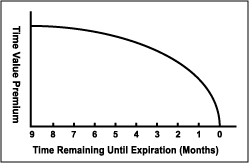
premium accelerates throughout the lifespan of the option. Time
decay is the best friend of option sellers and the worst enemy of option purchasers. The value of out-of-the-money options
is composed almost entirely of time value. The chart below depicts
the acceleration of the time decay of an option with a 9 month
lifespan from its inception to its expiration.
How much will an option premium move in relation to the underlying futures contract?
You can
approximate the move by finding out the delta factor of your option. The
delta factor tells you how much the change in premium should occur in your option based on the underlying future contract's movement. Let's say that you think Dec. gold will go up by $50/ounce or $5,000/contract
over a short period of time. You bought an option with a .20 or 20% delta factor. This option should gain approximately $1,000 in premium value of the $5,000 expected gold futures price movement
if it occurs in a timely manner.
Can an option speculator have a profit before the option has intrinsic value?
Yes, as long as the option premium increases enough to cover your transaction costs such as commission and fees. For example, you have a $3 Dec. corn call and Dec. corn is at $270/bushel and your transaction costs were $50. Let's say your option has a 20% delta and the Dec. corn future market moves up 10 cents/bushel to $2.80/bushel. Corn is a 5000 bushel contact so 1 cent multiplied by 5,000= $50. Your option premium will increase by approximately 2 cents = $100. Your break even was $50 so you have a $50 profit without any intrinsic value because you are still out of the money by 20 cents.
Conversely, the underlying futures market for your
options can move the direction that you anticipated but not quickly
enough to offset the time decay of the options. So, options can lose
money in spite of the underlying futures contract moving in a favorable
direction.
What is a bull call spread?
A bull call spread is a bullish strategy to take advantage of markets with high volatility option premiums. It involves the purchase of a at or close to the money call option and the granting of a further out of the money call option. The profit potential is the difference between the strike prices minus your costs and your risks are the cost of the trade. Example: buy 1 Dec. crude oil $70 call for $2,500 and sell 1 Dec. crude oil $75 call for $1,000. The cost of the trade is $1,500 ($2,500-$1,000) and your profit potential is $3,500 ($70-$75=$5 and crude is 1000 barrel contract so $5 multiplied by 1000=$5,000-$1,500 cost=$3,500).
What is a bear put spread?
A bear put spread is just like the bull call spread above but it uses puts instead of calls and is for speculating on a decline in prices. So you would buy an at or near the money put and grant a further out of the money put.
Learn More >>>
Futures Trading 101
Here is the introduction to futures guide from the CME Group.
Futures Brochure
What is a futures contract?
The unit of exchange that trades in the exchanges is the futures contract. Each contract provides for the future delivery of goods at a specified date, time, and place. Each particular commodity is bought and sold in standardized contractual units, which makes them completely interchangeable.
How old and how useful are the commodities markets?
The modern futures markets have been traded since rice futures traded in the eighteenth century in Osaka, Japan. However, historians have found some evidence of primitive futures contracts for olive oil, spices and other goods were used by shipping merchants in Persia before Christ. In the United States futures trading began in the mid-nineteenth century with corn contracts in Chicago and cotton contracts in New York.
The industrial revolution brought a new technology and the ability to produce more efficient tools and consequently more food. Economic output not only began to keep pace with the growing population but also increased the standards of living. This new productivity called for more agricultural storage, transportation, and more efficient distribution of goods.
At first the cash markets could handle the growing demand, but as quantities increased, the futures markets with uniform commodity pricing, grading, and delivery, became increasingly important. To cope with the gluts that occur during harvest times and with the shortages that occur before the harvest, purchasers could now protect themselves from price fluctuations by locking in a specific price for a commodity before they actually needed it.
So futures and options became necessary for producers, consumers and
investors.
Why do people invest in commodities?
Leverage is very important to the commodities markets. Unlike the stock market, where you might have to invest 10,000 dollars to leverage 10,000 dollars of a particular stock. A commodities trader can leverage tens of thousands of dollars worth of a commodity for pennies on the dollar. Also unlike stocks, commodities have intrinsic value and will not go bankrupt.
The futures markets are so crucial to the well being of our nation, that the government established the Commodity Futures Trading Commission (CFTC) to oversee the industry. There is also a self-regulatory body, the National Futures Association (NFA), who monitor the activities of all futures market professionals to ensure the integrity of the futures markets.
Commodities also give the investor the ability to participate in virtually all sectors of the world economy and have the potential to produce returns that tend to be independent of the stock, bond and real estate markets. In fact portfolios that add commodity investments can actually lower the overall portfolio risk by diversification.
What is the difference between hedging and speculating?
Just about every product that you consume would likely cost dramatically more without the commodities futures markets. Because of the intrinsic risks associated to being in business, lacking the ability to shift risk, a manufacturer/producer of goods or services would be forced to charge higher prices, and the consumer would have to pay higher prices. This shifting of risk to someone willing to accept it is called hedging. Manufacturers could effectively lock in a sales price by going short an equivalent amount of goods with futures contracts. If a mining company knew that they were going to sell 1000 ounces of gold in several months, they could protect themselves for a future price decline by going short 10 gold futures contracts or 10 gold put option contracts today. If the price of gold fell by $30 in the following months, they would receive that much less in the cash marketplace for their gold, but earn that much back when they offset their short gold futures or gold options positions. The futures price will eventually become the cash price. A user or buyer of goods can use the futures market in the same manner. They would need to protect themselves from a future price increase, and therefore go long futures contracts.
The person willingly accepting a risk does so because of the opportunity to profit from price movements, this is known as speculating. The cotton in your shirt, the orange juice, cereal and coffee you had for breakfast, the lumber, copper and mortgage for your home, the gas or ethanol that you put in your car all would be priced many times higher without the participation of speculators (you) in the futures markets. Through supply and demand market forces, equilibrium prices are reached in an orderly and equitable manner within the exchanges, and world economies, and you, benefit tremendously from futures trading.
What if I am not a large producer or consumer of a commodity and I just want to hedge my stock and bond portfolio?
The same thing applies to protecting your stock and bond portfolios from adverse market moves. If you have exposure in Dow Jones, S & P or NASDAQ stocks you can simply short the futures or buy puts on the index. If you are worried about higher interest rates hurting your fixed income investment prices, once again, you can short the futures or buy puts on your Treasury Bills, Notes and Bonds.
What does going long and going short mean?
To make a profit on any investment requires that something be bought and sold. When trading a futures contract it doesn’t matter if you initially sell or buy, as long as you do both before the contract comes due. If you were bearish you would sell, or go short. If you were bullish you would want to buy, or go long.
How do you sell something that you don’t own?
When trading futures, you never actually buy or sell anything tangible; you are just contracting to do so at a future date. You are merely taking a buying or selling position as a speculator, expecting to profit from rising or falling prices. You have no intention of making or taking delivery of the commodity you are trading, your only goal is to buy low and sell high or vice-versa. Before the contract expires you will need to relieve your contractual obligation to take or make delivery by offsetting your initial position. Therefore, if you originally entered a short position to exit you would buy, and if you had originally entered a long position, to exit you would sell.
How do trades take place?
Chicago Mercantile Exchange and most other U.S. futures exchanges offer two venues for trading: the traditional floor-trading venue and electronic trading. Broadly speaking, trading is essentially the same in either format: Customers submit orders that are executed – filled – by other traders who take equal but opposite positions, selling at prices at which other customers buy or buying at prices at which other customers sell. This matching of buyers and sellers occurs in both open outcry and electronic trading, but there are some differences between the two processes.
In open outcry trading, orders are communicated to brokers in a trading pit, via requests that customers make to their brokerages by phone or computer. Customer bids and offers are presented by pit brokers to other brokers standing in the pit, and trades are “executed” – matches are made – when prices that are mutually acceptable to buyers and sellers are identified. Customers are notified of their trades, information about each trade is sent to the clearing house and brokerages, and prices are disseminated immediately throughout the world. The trade order is also time-stamped at both ends of the process.
In electronic or screen-based trading, customers send buy or sell orders directly from their computers to an electronic marketplace offered by the exchange. There is no need to have brokers submit and execute orders for customers, because the customers will have received brokerage approval to trade electronically, and the exchange computer system informs the brokerages of customer activity. In a sense, the trading screen replaces the trading pit, and the electronic market participants replace the brokers standing in the pit. There is greatly expanded price transparency because the top five current bids and offers are posted on the trading screen for all market participants to see – an advantage that even brokers in a pit don’t have. The exchange computer system keeps track of all trading activity, and identifies matches of bids and offers, with fills generally made according to a first-in, first-out (FIFO) process, although some alternate allocation processes are used in particular markets. Trade information is sent to the clearing house and brokerage, and prices are also instantaneously broadcast to the public. Trades made on CME Globex exchange, for instance, are typically completed in a fraction of a second. In open outcry trading, however, it can take from a few seconds to minutes to execute a trade, according to the complexity of the order.
How does the process of price discovery work?
Futures prices increase and decrease largely because of the myriad factors that influence buyers' and sellers' judgments about what a particular commodity will be worth at a given time in the future (anywhere from less than a month to more than two years).
As new supply and demand developments occur and as new and more current information becomes available, these judgments are reassessed and the price of a particular futures contract may be bid upward or downward. The process of reassessment--of price discovery--is continuous.
Thus, in January, the price of a July futures contract would reflect the consensus of buyers' and sellers' opinions at that time as to what the value of a commodity or item will be when the contract expires in July. On any given day, with the arrival of new or more accurate information, the price of the July futures contract might increase or decrease in response to changing expectations.
Competitive price discovery is a major economic function--and, indeed, a major economic benefit--of futures trading. The trading floor of a futures exchange is where available information about the future value of a commodity or item is translated into the language of price. In summary, futures prices are an ever changing barometer of supply and demand and, in a dynamic market, the only certainty is that prices will change.
What happens after the closing bell?
Once a closing bell signals the end of a day's trading, the exchange's clearing organization matches each purchase made that day with its corresponding sale and tallies each member firm's gains or losses based on that day's price changes--a massive undertaking considering that nearly two-thirds of a million futures contracts are bought and sold on an average day. Each firm, in turn, calculates the gains and losses for each of its customers having futures contracts.
Gains and losses on futures contracts are not only calculated on a daily basis, they are credited and deducted on a daily basis. Thus, if a speculator were to have, say, a $300 profit as a result of the day's price changes, that amount would be immediately credited to his brokerage account and, unless required for other purposes, could be withdrawn. On the other hand, if the day's price changes had resulted in a $300 loss, his account would be immediately debited for that amount.
The process just described is known as a daily cash settlement and is an important feature of futures trading. As will be seen when we discuss margin requirements, it is also the reason a customer who incurs a loss on a futures position may be called on to deposit additional funds to his account.
Is the arithmetic of futures trading complicated?
To say that gains and losses in futures trading are the result of price changes is an accurate explanation but by no means a complete explanation. Perhaps more so than in any other form of speculation or investment, gains and losses in futures trading are highly leveraged. An understanding of leverage--and of how it can work to your advantage or disadvantage--is crucial to an understanding of futures trading.
As mentioned in the introduction, the leverage of futures trading stems from the fact that only a relatively small amount of money (known as initial margin) is required to buy or sell a futures contract. On a particular day, a margin deposit of only $1,000 might enable you to buy or sell a futures contract covering $25,000 worth of soybeans. Or for $10,000, you might be able to purchase a futures contract covering common stocks worth $260,000. The smaller the margin in relation to the value of the futures contract, the greater the leverage.
If you speculate in futures contracts and the price moves in the direction you anticipated, high leverage can produce large profits in relation to your initial margin. Conversely, if prices move in the opposite direction, high leverage can produce large losses in relation to your initial margin. Leverage is a two-edged sword.
For example, assume that in anticipation of rising stock prices you buy one June S&P 500 stock index futures contract at a time when the June index is trading at 1000. And assume your initial margin requirement is $10,000. Since the value of the futures contract is $250 times the index, each 1 point change in the index represents a $250 gain or loss.
Thus, an increase in the index from 1000 to 1040 would double your $10,000 margin deposit and a decrease from 1000 to 960 would wipe it out. That's a 100% gain or loss as the result of only a 4% change in the stock index!
Said another way, while buying (or selling) a futures contract provides exactly the same dollars and cents profit potential as owning (or selling short) the actual commodities or items covered by the contract, low margin requirements sharply increase the percentage profit or loss potential. For example, it can be one thing to have the value of your portfolio of common stocks decline from $100,000 to $96,000 (a 4% loss) but quite another (at least emotionally) to deposit $10,000 as margin for a futures contract and end up losing that much or more as the result of only a 4% price decline. Futures trading requires not only the necessary financial resources but also the necessary financial and emotional temperament.
What risks should I consider when trading?
An absolute requisite for anyone considering trading in futures contracts--whether it's sugar or stock indexes, pork bellies or petroleum--is to clearly understand the concept of leverage as well as the amount of gain or loss that will result from any given change in the futures price of the particular futures contract you would be trading. If you cannot afford the risk, or even if you are uncomfortable with the risk, the only sound advice is don't trade. Futures trading is not for everyone.
What is margin?
As is apparent from the preceding discussion, the arithmetic of leverage is the arithmetic of margins. An understanding of margins--and of the several different kinds of margin--is essential to an understanding of futures trading.
If your previous investment experience has mainly involved common stocks, you know that the term margin--as used in connection with securities--has to do with the cash down payment and money borrowed from a broker to purchase stocks. But used in connection with futures trading, margin has an altogether different meaning and serves an altogether different purpose.
Rather than providing a down payment, the margin required to buy or sell a futures contract is solely a deposit of good faith money that can be drawn on by your brokerage firm to cover losses that you may incur in the course of futures trading. It is much like money held in an escrow account. Minimum margin requirements for a particular futures contract at a particular time are set by the exchange on which the contract is traded. They are typically about five percent of the current value of the futures contract. Exchanges continuously monitor market conditions and risks and, as necessary, raise or reduce their margin requirements. Individual brokerage firms may require higher margin amounts from their customers than the exchange-set minimums.
There are two margin-related terms you should know: Initial margin and maintenance margin.
Initial margin (sometimes called original margin) is the sum of money that the customer must deposit with the brokerage firm for each futures contract to be bought or sold. On any day that profits accrue on your open positions, the profits will be added to the balance in your margin account. On any day losses accrue, the losses will be deducted from the balance in your margin account.
If and when the funds remaining available in your margin account are reduced by losses to below a certain level--known as the maintenance margin requirement--your broker will require that you deposit additional funds to bring the account back to the level of the initial margin. Or, you may also be asked for additional margin if the exchange or your brokerage firm raises its margin requirements. Requests for additional margin are known as margin calls.
Assume, for example, that the initial margin needed to buy or sell a particular futures contract is $2,000 and that the maintenance margin requirement is $1,500. Should losses on open positions reduce the funds remaining in your trading account to, say, $1,400 (an amount less than the maintenance requirement), you will receive a margin call for the $600 needed to restore your account to $2,000.
Before trading in futures contracts, be sure you understand the brokerage firm's Margin Agreement and know how and when the firm expects margin calls to be met. Some firms may require only that you mail a personal check. Others may insist you wire transfer funds from your bank or provide same-day or next-day delivery of a certified or cashier's check. If margin calls are not met in the prescribed time and form, the firm can protect itself by liquidating your open positions at the available market price (possibly resulting in an unsecured loss for which you would be liable).
Where does my money go when I open an account?
The cornerstone of the U.S. futures trading system is that no futures brokerage company is permitted to hold customer funds in any of its corporate bank accounts. According to strict regulations that are aggressively enforced by the CFTC and NFA, futures brokerage companies are required to maintain customer funds in bank accounts that are totally separate from their own bank accounts. By law, funds deposited by customers may never, under any circumstances, be commingled with the brokerage company's own funds. Your trading funds will always be carefully and securely held in a "customer segregated funds account."
What is a futures exchange?
A futures exchange, legally known in the U.S. as a “designated contract market,” is, at its core, an auction market – highly regulated, technical and complex – but an auction market nonetheless.
A futures exchange is the only place where futures and options on futures (which offer the right, but not the obligation, to buy or sell an underlying futures contract at a particular price) can be traded. Trading may take place either on the exchange’s trading floor or via an electronic trading platform. An exchange itself does not trade futures. Instead, it: -
Provides and maintains the facilities where buyers and sellers meet, ranging from traditional “trading pits” to global electronic trading networks -
Researches, develops and offers futures contracts to be traded -
Oversees the trading of its products and enforces trading-related rules and regulations -
Monitors and enforces financial and ethical standards -
Provides daily and historical data on the contracts traded under its auspices
Futures exchanges in the U.S. are subject to a great deal of regulation. They are monitored by the Commodity Futures Trading Commission (CFTC) and the National Futures Association (NFA). In addition, most futures exchanges practice intense self-regulation, monitoring their employees and the trading practices that occur in their facilities.
These agencies look after the public interest, ensure fair practice and monitor the process of price discovery that occurs in futures trading. Other governmental bodies, including the Securities and Exchange Commission, the Federal Reserve Board, and the U.S. Treasury Board also monitor some futures exchange functions. Violations of exchange rules can result in substantial fines, as well as suspension or revocation of trading privileges.
How many futures exchanges are there?
There are currently 13 futures exchanges registered in the U.S. but not all are hosting active trading. CME is the largest futures exchange in the U.S. by volume, and the first U.S. futures exchange to become a for-profit corporation, after revising its original private membership structure and a becoming publicly traded company in 2002. Most U.S. exchanges remain not-for-profit, private membership organizations, but a number of them are actively weighing the advantages of changing to stock corporations.
There are more than 50 futures exchanges worldwide, and they are structured in a number of different ways. Some futures exchanges are owned by groups of banks or by a stock exchange holding company. Other exchanges, or their holding companies, are publicly listed on a stock exchange, similar to CME.
How do futures exchanges earn money?
Since futures exchanges do not themselves engage in trading, people sometimes wonder how they earn money. Futures exchanges earn income primarily by: -
Receiving a fee for every trade made through the exchange. -
Selling price data – current, streaming price data in real time as well as historical price data on trades made through the exchange. At CME, data subscription services include CME E-quotes™ and CME E-history. -
Charging for clearing services, if the futures exchanges own their own clearing house, as is the case with CME. Some exchanges outsource the clearing function. The Chicago Board of Trade, for example, has its contracts cleared through the CME Clearing House.
To learn more visit future trading strategy, option trading strategy and investment glossary. SITE MAP
|